

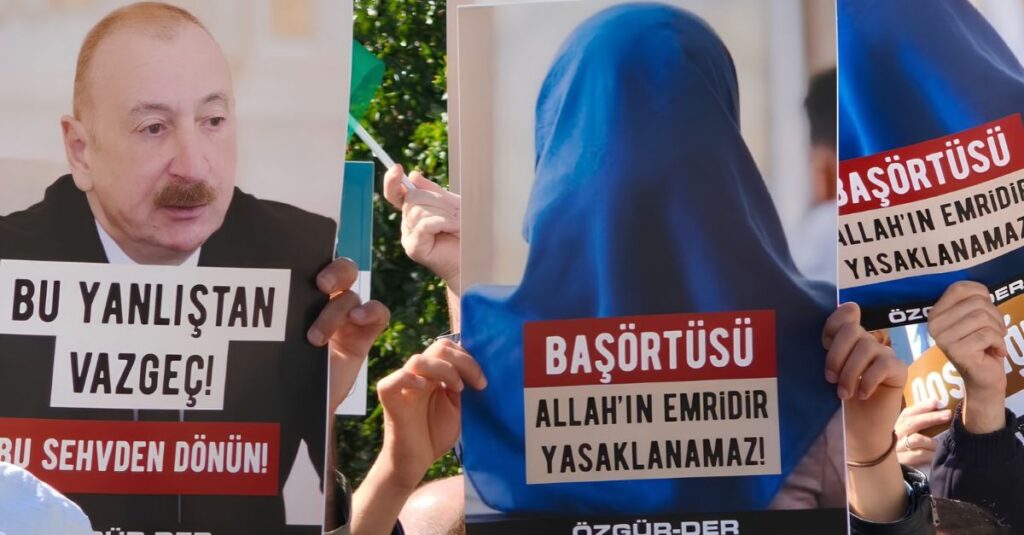
Protests have erupted across Azerbaijan after the introduction of new school dress code regulations effectively barring students and teachers from wearing hijabs in public schools.
The regulations, enacted on September 21 by Azerbaijan’s Cabinet of Ministers, do not explicitly ban the Islamic headscarf but prohibit any clothing incompatible with secular education or the mandated school uniform. In practice, reports show that students and teachers wearing hijabs have been denied entry to classrooms, sparking outrage nationwide.
The Cabinet of Ministers adopted the updated uniform requirements on Sept. 21, stating the policy prohibits clothing deemed inconsistent with the principle of secular education. While the rules do not explicitly reference the hijab, reports indicate instances where students and teachers wearing headscarves have been prevented from entering school premises, sparking demonstrations across the country.
Videos circulating on social media depict students outside school gates, some embracing their teachers or crying after being turned away for wearing headscarves. Demonstrators have expressed their frustration in various ways, from boycotting classes at multiple schools to organizing protests outside school buildings.
Authorities announced that 37 individuals were detained this week in Baku for what the Interior Ministry described as disruptions to public order during the protests. The ministry stated that detainees were accused of damaging property, blocking traffic, and clashing with education officials. A criminal case has been opened under laws concerning the organization of public disturbances.
The uniform rules have also affected teachers. Educator Zahra Hasanova said she was informed she could no longer wear her hijab at school. “To be honest, I am a little emotional. I am hurt,” she told Al Jazeera. “The hijab is a personal choice, and if one day I want to take it off, that should be my decision too.”
Critics argue the regulations disproportionately impact Muslim students and teachers in Azerbaijan, where approximately 96% of the population identifies as Muslim. The government, meanwhile, has defended the dress code as necessary to safeguard the country’s secular education system.
The hijab rules have also drawn criticism from neighboring Turkey, a close ally of Azerbaijan. On Monday, Oktay Saral, a senior adviser to Turkish President Recep Tayyip Erdogan, called the restrictions “unacceptable” in a social media post, adding that preventing students from attending school for wearing headscarves contradicts religious freedoms.
In response, Azerbaijan’s ruling Yeni Azerbaijan Party (YAP) described Saral’s remarks as “populist and irresponsible,” stressing that Azerbaijan’s domestic policies should not be subject to external interference. President Ilham Aliyev later warned of ideological interference during a party congress but did not directly reference Turkey.
Protests against Azerbaijan’s hijab rules have also spread to Istanbul, where demonstrators gathered outside Azerbaijan’s consulate, calling on officials to repeal the restrictions.